As a supplier of T1 50KA Surge Protective Devices (SPDs), I’ve spent the last decade explaining this piece of equipment to electricians, facility managers, and even fellow engineers who’re new to surge protection. Most people I talk to initially understand that “surge protectors keep devices safe” — but they don’t always get why T1 50KA units are different, or why sticking to that specific rating isn’t just a random number I throw around to sell gear. Let me break this down, plain and simple, no overly complex jargon — just real-world answers that’ve helped hundreds of my clients avoid costly downtime. T1 50KA Surge Protective Device
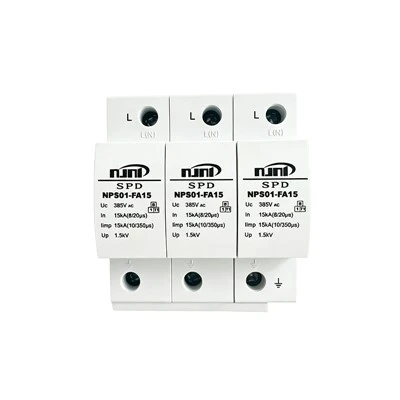
First, let’s ground this in what a surge even is. Most power systems are designed for steady, smooth 120V or 240V AC current. But surges — sudden spikes of extra voltage that can reach hundreds or thousands of volts for just millionths of a second — happen all the time. Some are tiny, from a microwave kicking on or a fridge compressor cycling. Others are catastrophic: a lightning strike near your building, a downed power line, or even switching operations on the utility grid nearby. It’s the big surges that do damage — a single spike can fry circuit boards in seconds, turning a $500 server or $5,000 HVAC unit into a paperweight before you even realize what hit it.
Now, why T1? That’s a classification from the Institute of Electrical and Electronics Engineers (IEEE) and International Electrotechnical Commission (IEC) — the two bodies that set global safety and performance standards for electrical gear. T1 specifically applies to surges that come directly from the utility grid, most often from nearby lightning strikes. Unlike T2 or T3 SPDs, which protect against smaller, internal surges (the kind from your building’s own equipment), T1 units are the first line of defense at the point where your building connects to the utility service. Think of it like a bouncer at a club: it stops the biggest, most dangerous troublemakers before they even get inside.
The 50KA rating is the other key part here. That number refers to the maximum current the SPD can safely divert to the ground during a surge, measured in kiloamps. Let’s put that in perspective: a small household surge might be 10KA, and a typical T2 SPD handles around 20KA. A 50KA T1 SPD? That’s built for the massive surges from direct or very nearby lightning, which can hit 100KA or more. I’ve seen too many installers cut corners by using a cheaper 20KA or 35KA T1 unit because it’s less expensive — and that only works if you never get a really big surge. Last year, a customer of mine who’d skipped the 50KA unit had a lightning strike take out three of their main server racks, costing them $120,000 in downtime and repairs. They came back to us within a month to upgrade their entire system with our 50KA T1 units. It’s not just about being overcautious — it’s about matching the rating to the risk.
So what exactly does a T1 50KA SPD do step-by-step when a surge hits? Let’s walk through it, because most people think it just “absorbs” power, but it’s a lot more precise than that. Under normal conditions, the SPD sits dormant, pulling almost no power from the line — it’s just waiting. When a surge comes, two things happen fast, in microseconds (that’s a millionth of a second, so fast you can’t see it): first, the SPD’s metal oxide varistor (MOV) — the core component of every SPD I supply — recognizes the extra voltage. MOVs are made of a special ceramic material that acts like an insulator at normal voltages, but becomes a conductor the second voltage crosses a set threshold, like 160V for a 120V system. That’s the trigger.
Next, the 50KA capacity kicks in. The MOV doesn’t just conduct a little current — it directs the entire excess surge current away from the sensitive building electrical systems, straight to the building’s grounding system. Grounding isn’t just a safety feature for shocks; it’s the release valve for surges. The T1 unit is designed to carry that huge 50KA load without breaking down, heating up, or failing. If it couldn’t handle that current, the surge would instead flow through your wiring, through your devices, and fry them. And here’s a key point: a good T1 50KA SPD won’t interrupt normal power, won’t cause dips or blips in your service, and won’t need to be replaced after every small surge — only after it’s hit with a big one that reaches its 50KA limit.
Now, who needs a T1 50KA SPD? I get this question all the time. It’s not just for big office buildings or data centers — though those are the most common buyers. It’s for any location where a surge could cause major financial or operational loss. Think of farms with expensive irrigation and climate control systems, hospitals with critical life support equipment, retail stores with point-of-sale systems that can’t go down during holiday weekends, or even small manufacturing facilities where a single surge could stop a production line that costs $10,000 an hour to run. For residential properties, a T2 unit is often enough, but if you’re in a lightning-prone area (like Florida, the Pacific Northwest, or the Great Plains) or have a whole-home system with high-end electronics, a T1 50KA at the main breaker panel is a smart add-on.
I’ve had customers argue with me that a 35KA T1 unit is “good enough” — it’s cheaper, after all. But the math doesn’t lie. A 50KA unit can handle 43% more current than a 35KA one, and that extra capacity doesn’t cost nearly as much as repairing the damage if a surge exceeds the lower unit’s rating. Last year, I worked with a small warehouse in Oklahoma that had a 35KA T1 unit installed by a handyman. A summer thunderstorm with 12 lightning strikes within 2 miles hit, and one generated a surge of 42KA — just under the 50KA rating, but way over the 35KA unit’s limit. The SPD burned out, and the surge traveled through their wiring, taking out their 10-ton HVAC unit and 8 forklift batteries. The total cost? $18,000, compared to the $200 difference between a 35KA and 50KA unit. That’s a callous number, but it’s the reality I see every day.
Another point that confuses people: T1 vs. other SPD types, and why the 50KA rating is specific to that classification. T1 units are “Type 1” SPDs per IEC 61643-11, which means they’re installed at the service entrance — the first point where power enters your building. Type 2 (T2) are at sub-panels or near individual equipment, and Type 3 (T3) are for specific sensitive devices like computers. The 50KA rating is the maximum surge current the Type 1 unit can handle, and that’s non-negotiable for utility-front protection. A T2 unit might have a higher continuous rating, but it’s not built to handle the massive surges that come directly from the grid during a lightning event. Trying to use a T2 as a T1 is like using a garden hose to put out a house fire — it’s not built for that load.
As a supplier, I also make sure every T1 50KA SPD I sell is tested and certified to IEC and UL standards. Certification isn’t a marketing buzzword — it means an independent lab has tested the unit to make sure it actually delivers the 50KA rating, not just claims it on the box. I’ve seen cheap, uncertified units online that say “50KA T1” but can barely handle 20KA before failing. That’s a risk I won’t pass on to my customers. When you buy from me, you get a unit that’s been through thermal cycling tests (to make sure it works in extreme heat or cold), current surge tests, and lifespan tests to ensure it’ll last for 10 to 15 years, the typical service life for an SPD.
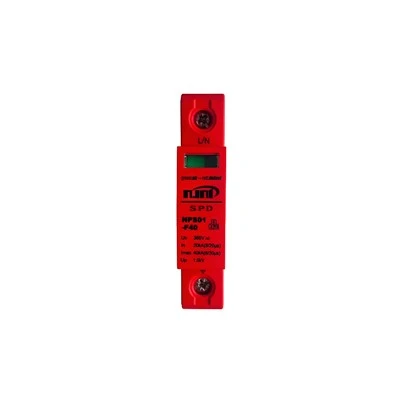
One common misconception is that SPDs are “set it and forget it” devices. They do need occasional inspections, especially after a major surge event. Most of the T1 50KA units I supply have a visual indicator light — green means they’re working, red means they’ve hit their limit and need to be replaced. That’s a simple check, but it’s an important one. I always tell my clients to mark their calendar to do a visual check once a year, or after any severe thunderstorm or grid switching event (like when the utility does maintenance on power lines).
So putting it all together, the function of a T1 50KA Surge Protective Device is threefold: first, it acts as the primary line of defense at your building’s power entry point, stopping the largest, most dangerous surges from the utility grid (the kind caused by lightning or grid switching) before they reach your sensitive equipment. Second, its 50KA current rating means it can handle those massive surges safely, without failing, overheating, or letting excess current pass through to fry your electronics. Third, it’s designed to work in the background, only activating when a surge hits, so it doesn’t disrupt normal power flow or require constant maintenance.
I’ve spent years talking to customers who’ve had their own horror stories about surge damage, and the one takeaway everyone has is that investing in the right protection is way cheaper than fixing the aftermath. A T1 50KA unit isn’t a luxury — it’s a critical component of any electrical system in areas at risk of surges. If you’re not sure if your current setup has the right protection, or if you need to upgrade to a T1 50KA SPD, I’m here to help. We work with commercial facilities, industrial sites, and residential properties across the country, and we can provide custom assessments tailored to your specific needs.
T1+T2 7KA Surge Protective Device References
IEC 61643-11: Low-voltage surge protective devices – Part 11: Surge protective devices connected to low-voltage power systems – Requirements and test methods
Underwriters Laboratories (UL) 1449: Standard for Safety for Surge Protective Devices
IEEE C62.41: IEEE Recommended Practice on Surge Voltages in Low-Voltage AC Power Circuits
National Electrical Code (NEC) Article 285: Surge Protective Devices
Nanjing Ningpu Lightning Protection Equipment Manufacturing Co., Ltd.
As one of the most professional T1 50ka surge protective device manufacturers and suppliers in China, we’re featured by quality products and good price. Please rest assured to buy customized T1 50ka surge protective device made in China here from our factory. Also, pricelist is available.
Address: Building 1, No.20 Shengyuan Road, Lishui Economic Development Zone, Nanjing City, Jiangsu Province, China
E-mail: 3796023563@qq.com
WebSite: https://www.npspd.com/
